

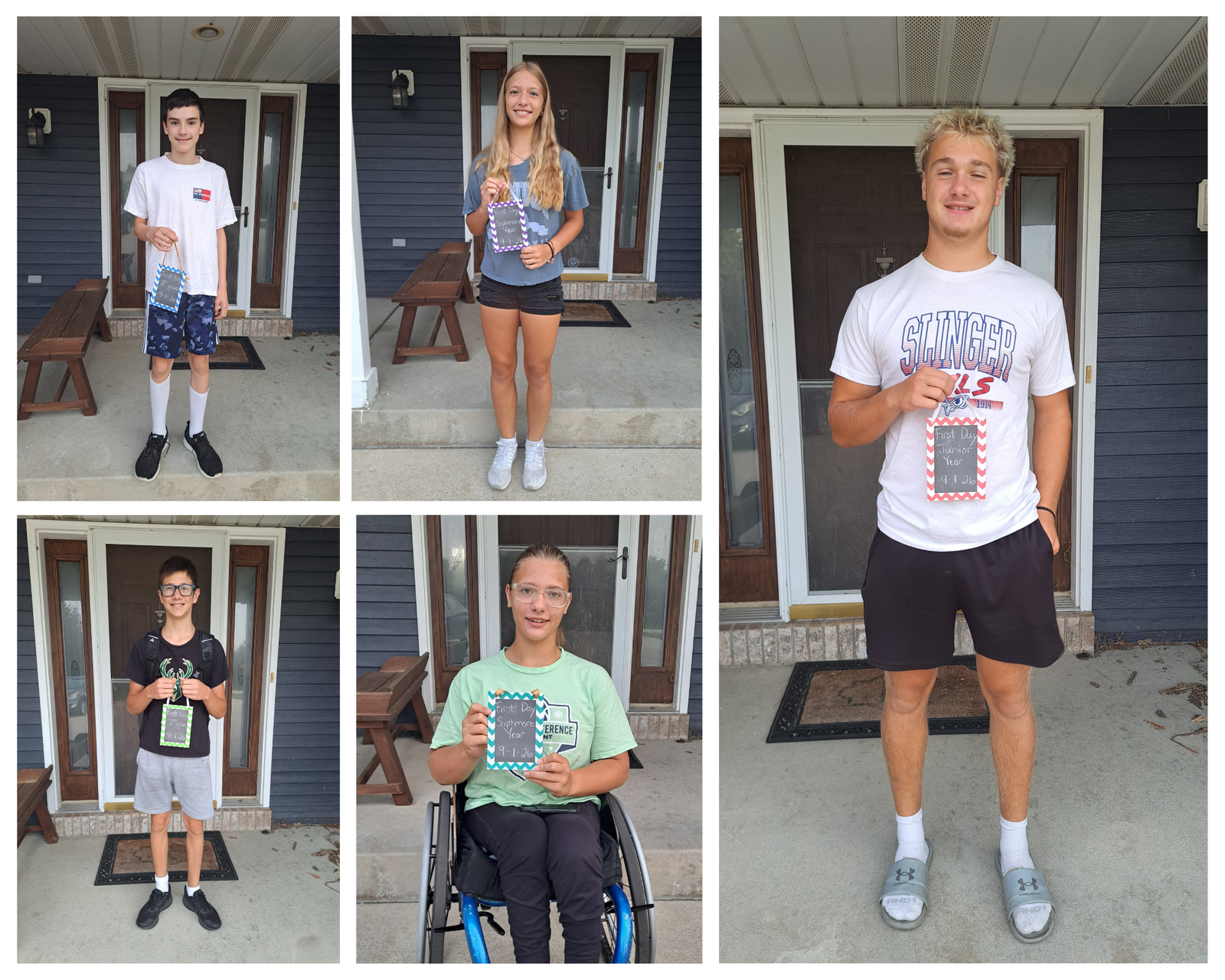
This morning was the first day of school.
Like many moms, I wanted to get the traditional first-day-of-school pictures. Kids dressed and ready. Backpacks on. Another milestone documented.
And then I did something different. I only took one picture of each kid. I didn’t even get a group picture.
Normally, I would take several. One kid isn’t looking at the camera. Take another. There’s a goofy, weird smile. Take another. And let’s just get one more to be safe. Then later, I would have five nearly identical pictures sitting on my phone and at some point, I’d have to decide which ones to keep. Except… when is “some point”? That was the thought that hit me this morning.
When Did Every Moment Need 10 Versions?
I’m an Elder Millenial (otherwise known as the Oregon Trail Generation… IYKYK!) and grew up in the era of cameras with actual film that you had to go and get developed to see the picture. You took the picture, hoped everyone looked reasonably normal, and waited to see how it turned out.
There was no checking the screen. No taking 17 versions just in case. And unless you wanted to spend a small fortune developing extra film, you were somewhat intentional about what you photographed. While I love being nostalgic about the 90’s, I’m definitely not suggesting we go back to that.
Digital cameras are amazing. I love having lots of pictures of my kids. And honestly, there are plenty of times when taking multiple shots makes complete sense. Kids move. Someone blinks. The baby suddenly makes an adorable face.
But this morning made me think about something else: What is the mental cost of having so many pictures to sort through later?
Because digital clutter is still clutter. And just like the piles in our closets or the boxes in our basements, every extra thing eventually becomes another decision waiting for us.
More Choices Don’t Always Make Things Easier
Think about the last family event you attended. Maybe it was a birthday party, holiday gathering, wedding, or family vacation. Someone creates a shared album and suddenly everyone is adding their pictures. I love this, there are always pictures that someone else captured that I never would have gotten myself. A candid moment with my kids or a conversation I didn’t realize was happening. A picture of the whole family because, for once, I was actually in the photo too.
Those pictures are a gift. But then there’s the other side of it.
You might end up with 15 slightly different pictures of the same group standing in the same spot. Or multiple versions of the same moment taken from different phones. And when it comes time to look through them all, save your favorites, or decide which ones you actually want to keep, it can become surprisingly overwhelming.
You start comparing. Is this one better? Wait, in that one, Grandma is looking at the camera, but I like my kid’s smile better in this one. After a while, they all start to blend together. And that’s when I think we run into an interesting problem:
Sometimes having more options actually makes the decision harder.
And I think the same thing happens with the pictures on our phones, the abundance of choices is the clutter.
It’s Not About Taking Fewer Pictures
If you regularly take 15 pictures of the same moment, ask yourself: What happens to the other 14? Do you actually go back and look at them? Do they all tell a different part of the story? Or are they just slightly different versions of the same memory? There isn’t a right answer.
But if scrolling through thousands of photos on your phone feels overwhelming, working backward from that problem might help. Maybe you don’t need to stop taking multiple pictures. Maybe you just challenge yourself to take five instead of 15.
Or maybe you simply get better at processing the extras afterward so they don’t quietly turn into another overwhelming project waiting for you someday.
How to Declutter Digital Photos: A Simple Step-by-Step Guide
If your camera roll feels completely out of control, please don’t start at the beginning and try to organize your entire photo library! That’s the digital equivalent of pulling everything out of every closet in your house at once, which is a one way ticket to ending up frustated and giving up on the project!
Instead, start small.
Step 1: Pick One Small Batch
Start with a single event. Try something like:
- Last year’s vacation
- One birthday party
- Last Christmas
- Your child’s most recent sports season
- The photos you took last weekend
Choose one small batch that feels manageable – if you took 500 pictures on vacation, break that down even further to maybe one day or activity. The goal is to find an easy win so this is a positive experience, not a negative one.
Step 2: Get Rid of the Easy Ones First
You don’t have to make a deep, emotional decision about every picture. Start with the obvious ones.
Delete:
- Blurry pictures
- Accidental screenshots
- Pictures where someone’s eyes are closed
- Completely duplicate photos
- Random pictures you have no reason to keep
This gives you some quick wins before you get to the harder decisions.
Step 3: Use a Decision Lens to Choose Your Favorites
When you’re staring at 10 nearly identical pictures, it can be hard to decide which ones to keep. Instead of asking, “Is this picture good enough to keep?” try asking a different question.
Would I print this?
This is my favorite question to use when sorting through pictures. If I were making a photo album or choosing a picture to put in a frame, would this be one I’d choose?
And here’s another helpful version of the same question:
Would I post this?
Think about it. If you take 10 pictures of the same moment, you’re probably not posting all 10 versions online. You’re going to scroll through and pick your favorite one or two.
Once you’ve already made that decision, why keep all the nearly identical versions?
Of course, you might not actually post your pictures, though it’s the same idea as if you’re going to text someone – you wouldn’t text all 10 versions of the same picture. Use this question as your guide:
If I were going to share one of these, which would I choose?
Sometimes we keep every version simply because we haven’t given ourselves a reason to choose.
Using a simple decision lens, whether that’s Would I print this? or Would I post this?, can help you identify your favorites without overthinking every single photo. This makes it much easier to determine which ones to keep and is a total game changer when organizing your digital pictures.
Step 4: Choose the Picture That Best Tells the Story
Of course, not every picture has to be frame-worthy. Sometimes the technically imperfect picture is the one that captures the memory best.
Maybe everyone is laughing. Maybe your child’s face is slightly blurry because they were running around, but that’s exactly who they were at that age. Maybe it’s not the picture you’d post online, but it reminds you of something that happened that day.
Those pictures matter too. The goal isn’t to narrow every event down to one perfect photo. It’s simply to ask: Does this picture add something to the memory? If it does, keep it.
If it’s basically the same picture as five others, give yourself permission to choose your favorite and delete the rest.
Step 5: Think About the Pictures You’re Leaving Behind
Here’s another aspect I think is important to consider: your digital legacy.
Most of us take pictures because we want to preserve memories. We want to remember our kids when they were little, they change so quickly and we want to capture the everyday moments we’ll someday forget. And, whether we consciously think about it or not, we’re creating a collection of memories that may eventually be passed down to our children.
But here’s something worth thinking about: Will your kids actually want to sort through 75,000 photos someday? Especially when hundreds of them are nearly identical?
Imagine one of your kids wanting to find pictures from their childhood, whether it’s baby pictures for a graduation slideshow or maybe they’re getting married and want to include childhood photos. Maybe they simply want to sit down one day, look back at their life, and share those pictures with their children.
Now imagine trying to find those meaningful pictures buried among thousands and thousands of screenshots, duplicates, blurry photos, and 14 slightly different versions of the same moment. That’s a pretty daunting project. And when a project feels overwhelming enough, sometimes it’s easier to just give up on it.
This isn’t about creating a perfectly curated photo archive. It’s about making sure the memories that matter don’t get lost in the volume.
As you’re sorting through your pictures, ask yourself: If someone I loved was looking through these someday, would this picture help tell the story? That doesn’t mean every picture has to be perfect or worthy of a frame. Sometimes the imperfect, candid pictures are the ones that tell the best stories.
But it might help you make decisions about those 12 nearly identical pictures. You don’t have to preserve every version of a moment to preserve the memory. Sometimes keeping the best few makes the meaningful ones easier to find.
Step 6: Don’t Turn It Into Another Huge Project
You don’t need to spend an entire Saturday organizing your phone. Just like I recommend with decluttering physical items, try cleaning up photos in small pockets of time.
Waiting in the school pickup line? Delete a few duplicates. In line at the store? Choose a batch to work on. Waiting at an appointment? Go through one recent event.
You could even make it a habit to do a quick cleanup after a big event or vacation, while the memories are still fresh and before hundreds more pictures pile up on top of them.
Small progress always counts. And start with the most recent photos in your phone, don’t put extra pressure on yourself to go way back. Just work on a few photos at a time, it all adds up.
Give Yourself Permission to Choose “Good Enough”
I think this might be the bigger lesson, not just with pictures, but with decluttering in general. We often make things harder because we’re searching for the perfect decision. The perfect picture. The perfect one to keep. The perfect organizing system. The perfect time to tackle the project. Spoiler alert: there’s no such thing!
And sometimes, all those extra options and decisions become the very thing keeping us stuck.
So maybe the goal isn’t to take only one picture. Maybe it’s simply to remember that more isn’t always better. More options don’t always make decisions easier. More pictures don’t always preserve a memory better.
And you don’t have to keep every version of something just because you have the ability to, sometimes choosing one is enough.
And reality check? I bet you didn’t even notice several of the kids weren’t wearing their backpacks in the pictures on this post until I just pointed that out. So those slightly imperfect first-day-of-school pictures I took this morning?
They captured the moment exactly as it happened, and it turned out just fine.